「先進エネルギー論」/「先進エネルギー特論」
目次
ガイダンス
本講義では、分子動力学法を中心に、分子シミュレーションの理論と応用を学びます。歴史的背景をたどりながら、古典力学に基づく運動方程式、ポテンシャル関数、統計力学との関係など、基礎となる物理化学的概念と計算手法を解説します。
演習では、材料を主な対象として、モデルの設定から計算の実行、結果の出力までを体験します。各自PCを持参し、シミュレーションプログラムの使い方と、Pythonによる数値計算・データ処理・可視化の基礎を身につけます。
得られた構造やエネルギー、拡散係数、自己相関関数を解析し、計算結果から物理化学的な情報を読み取る力を養います。分子シミュレーションを材料科学・物理化学の研究に活用するための基礎を身につけることが目標です。
成績評価について
授業への参加度合いとレポートの内容で評価します。
分子動力学計算の理論と実行
分子動力学計算の理論
分子動力学計算の基礎理論と歴史、LAMMPSの概要を説明します。
各自のPCでLAMMPSによるMD計算を実行し、ログを確認して、計算結果をVMDで可視化できるようになることを目標とします。
LAMMPS
Windows
LAMMPSは、無料で利用できる汎用分子動力学計算プログラムです。コマンドラインから入力ファイルを指定して、MD計算を実行します。講義用に実行環境を用意していますので、以下の手順で準備してください。
- LAMMPSのWindows用バイナリファイル(lammps_win64.zip)をダウンロード して展開します。
展開した
lammpsフォルダをC:\lammpsに配置します。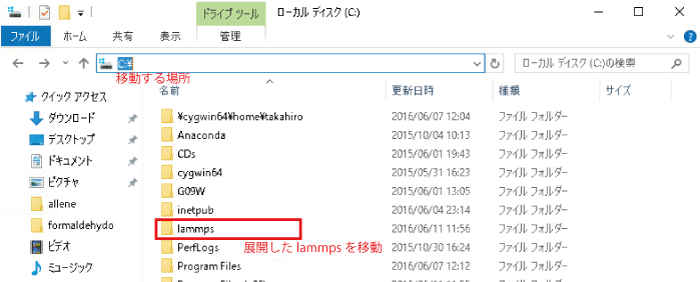
Windowsのスタートメニューを開いて「command」を検索し、コマンドプロンプトを開きます。
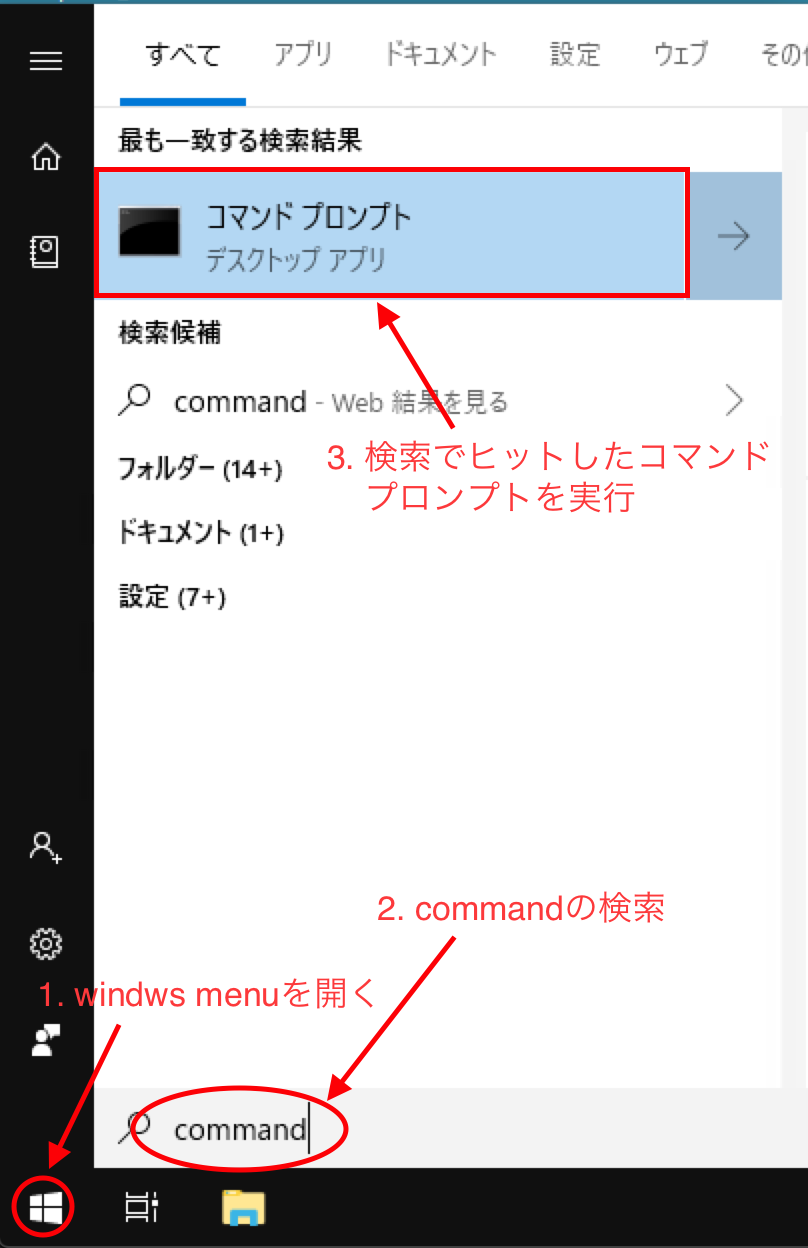
以後はコマンドプロンプトで作業します。まず、次の基本操作を覚えてください。上矢印キー(↑)でコマンドの履歴を呼び出せます。
cd folder_name 指定したフォルダに移動
cd ..          1つ上のフォルダに移動
dir            フォルダ内のファイル一覧を表示(macOSではls)
Ctrl+C         実行中のプログラムを中断
次のコマンドで C:\lammps に移動し、サンプル計算を実行します。
cd /d C:\lammps
lmp -in sample.in
次のように計算結果が表示され、 ERROR が出ずに計算が終了し、
作業フォルダに log.lammps が生成されることを確認してください。
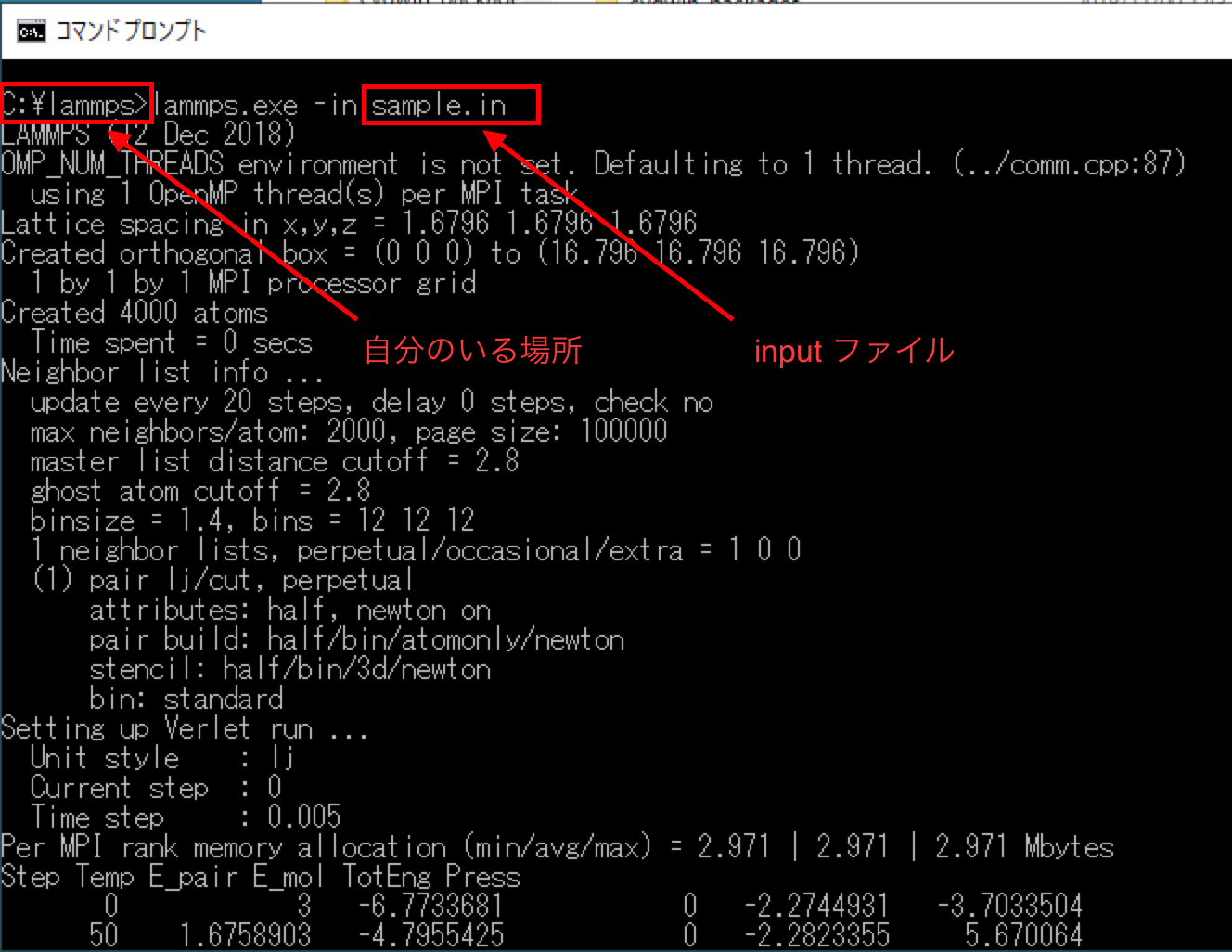
細かい数字は上の出力結果と異なっていても問題ありません。
macOS
- lammps_osx_arm64.zip (Apple Silicon: arm64)
- lammps_osx_x86.zip (Intel: x86_64)
- 自分のMacに合ったZIPファイルを展開し、ターミナルで
lammpsフォルダの一つ上のフォルダに移動します。 次のコマンドでlammpsフォルダに移動し、サンプル計算を実行します。 実行ファイルのパスを示す./を忘れないようにしてください。 Windowsの場合と同様に、ERRORが出ずに計算が終了し、log.lammpsが生成されることを確認してください。
cd lammps
./lmp -in sample.in
Linux
インストール方法はLinux向けの公式手順を参照してください。
VMD
VMDはLAMMPSから得られた計算結果を可視化するプログラムです。公式サイトでユーザー登録してから自分のOSに合ったファイルを入手してください。
- Windows: 展開した
VMDフォルダ内のvmd.exeを実行します。 日本語を含まないパスに配置してください。 - macOS: 展開したVMDアプリ(=.app=)を「アプリケーション」フォルダなどに 移し、起動します。Apple Silicon用とIntel用を選び分けてください。
- Windows用: vmd_win32.zip
- macOS用 (Apple Silicon: arm64): vmd_osx_arm64.tgz
- macOS用 (Intel: x86_64): vmd_osx_x86.zip
Pythonによるデータ解析
Pythonを用いて、MD計算で出力される統計データや座標データを解析できるようになることを目標とします。
Python実習
Google Colabを利用してPythonの基礎とデータ解析を説明します。各自、大学から提供されているGoogleアカウントでログインしてください。
Web版の講義資料も参照してください。
液体ArのMD
参考論文
- Correlations in the Motion of Atoms in Liquid Argon.pdf
- Author: A. Rahman (Argonne National Laboratory)
- Physical Review, 136, A405–A411 (1964)
- Abstract: A system of 864 particles interacting with a Lennard-Jones potential and obeying classical equations of motion has been studied on a digital computer (CDC 3600) to simulate molecular dynamics in liquid argon at 94.4 K and a density of 1.374 g/cm3. The pair-correlation function and the constant of self-diffusion are found to agree well with experiment; the latter is 15% lower than the experimental value. The spectrum of the velocity autocorrelation function shows a broad maximum in the frequency region ω = 0.25(kBT/ℏ). The shape of the Van Hove function Gs(r,t) attains a maximum departure from a Gaussian at about t = 3.0 × 10⁻¹² sec and becomes a Gaussian again at about 10-11 sec. The Van Hove function Gd(r,t) has been compared with the convolution approximation of Vineyard, showing that this approximation gives a too rapid decay of Gd(r,t) with time. A delayed-convolution approximation has been suggested which gives a better fit with Gd(r,t); this delayed convolution makes Gd(r,t) decay as t4 at short times and as t at long times.
液体Arの分子動力学計算
入力ファイル(PCで実行する例)
- 論文と同じ密度1.374 g/cm3を用いる入力例: Ar.zip
- 入力ファイルを読み、各設定を確認します。解説: Ar_in_data.pdf
- LAMMPSの
-inで入力ファイル、-logでログの保存先を指定します。 - エネルギーや温度などが画面に表示されます。
-log Ar.logを指定すると、同じ内容がAr.logに保存されます。Ar.inの温度や計算時間を変えて実行してください。 - LAMMPSの内蔵機能で動径分布関数と平均二乗変位を計算する入力例: Ar_nvt.zip
- これらの入力例とColab Notebookでは計算条件が異なります。使用する入力ファイルの設定を確認してください。
アルカリハライド溶融塩のMD
参考論文
- Dispersion and Polarizability and the van der Waals Potential in the Alkali Halides
- Interatomic Distances in Crystals of the Alkali Halides
- J. Chem. Phys., 1, 643-646 (1933)
- Abstract: The constants of the empirical repulsion potential assumed by Born and Mayer between two ions, which may be termed the ionic "radii," are calculated for the alkali and halide ions from the lattice constants of the alkali halides. By using 9 such radii the 20 lattice constants can be recalculated nearly within the probable experimental error of their determination. The good agreement is regarded as support for the assumptions involved in the calculations.
- Ionic sizes and Born repulsive parameters in the NaCl-type alkali halides—I
- Authors: F. G. Fumi and M. P. Tosi
- J. Phys. Chem. Solids, 25, 31-43 (1964)
- Abstract: The Born model of ionic solids is shown to permit the complete determination from solid-state data of crystal radii for the alkali and halogen ions in the individual alkali halides with the NaCl structure, which are directly comparable with the experimental crystal radii deducible from the X-ray maps for the electron distribution in the crystal.
- Ionic sizes and Born repulsive parameters in the NaCl-type alkali halides—II
- Authors: M. P. Tosi and F. G. Fumi
- J. Phys. Chem. Solids, 25, 45–52 (1964)
- Abstract: The procedure described in I for the determination of the crystal radii of the ions in the individual NaCl-type alkali halides from solid-state data by the Born model is applied, adopting a generalized Huggins-Mayer form for the Born repulsive energy (i.e. allowing the hardness parameter to vary from salt to salt).
- Calculation of the melting point of NaCl by molecular simulation
- Authors: J. Anwar, D. Frenkel, and M. G. Noro
- J. Chem. Phys., 118, 728-735 (2003)
- Abstract: We report a numerical calculation of the melting point of NaCl. The solid–liquid transition was located by determining the point where the chemical potentials of the solid and liquid phases intersect.
実習: NaClの分子動力学計算
入力ファイル(PCで実行する例)
- 入力ファイル: NaCl_lammps.zip
NaCl.inを読み、各設定を確認します。解説: NaCl.in.pdf- この入力例は300 KのNaClを扱います。Colab Notebookの溶融塩とは計算条件が異なります。
イオン液体のMD
講義資料
参考論文
- Modeling Ionic Liquids Using a Systematic All-Atom Force Field
- Authors: José N. Canongia Lopes, Johnny Deschamps, and Agílio A. H. Pádua
- J. Phys. Chem. B, 108, 2038–2047 (2004)
- Abstract: A new force field for the molecular modeling of ionic liquids of the dialkylimidazolium cation family was constructed. The model is based on the OPLS-AA/AMBER framework. Ab initio calculations were performed to obtain several terms in the force field not yet defined in the literature. These include torsion energy profiles and distributions of atomic charges that blend smoothly with the OPLS-AA specification for alkyl chains. Validation was carried out by comparing simulated and experimental data on fourteen different salts, comprising three types of anion and five lengths of alkyl chain, in both the crystalline and liquid phases. The present model can be regarded as a step toward a general force field for ionic liquids of the imidazolium cation family that was built in a systematic way, is easily integrated with OPLS-AA/AMBER, and is transferable between different combinations of cation–anion.
- Molecular Force Field for Ionic Liquids Composed of Triflate or Bistriflylimide Anions
- Authors: José N. Canongia Lopes and Agílio A. H. Pádua
- J. Phys. Chem. B, 108, 16893–16898 (2004)
- Abstract: A set of force field parameters is proposed for the molecular simulation of ionic liquids containing the anions trifluoromethylsufate and bis(trifluoromethylsulfonyl)imide, also known as triflate and bistriflylimide, respectively. The new set can be combined with existing force fields for cations in order to simulate common room-temperature ionic liquids, such as those of the dialkylimidazolium family, and can be integrated with the OPLS-AA or similar force fields. Ab initio quantum chemical calculations were employed to obtain molecular geometry, torsional energy profiles, and partial charge distribution in the triflate and bistriflylimide anions. One of the torsions in bistriflylimide, corresponding to the dihedral angle S-N-S-C, has a complex energy profile which is precisely reproduced by the present parameter set. A new set of partial electrostatic charges is also proposed for the pyrrolidinium and tri- and tetra-alkylammonium cations. Again, these parameters can be combined with the OPLS-AA specification for amines in order to simulate alkylammonium salts. The force-field models were validated against crystal structures and liquid-state densities.
- Development of OPLS-AA Force Field Parameters for 68 Unique Ionic Liquids
- Authors: Somisetti V. Sambasivarao and Orlando Acevedo
- J. Chem. Theory Comput., 5, 1038–1050 (2009)
- Abstract: OPLS-AA force field parameters have been developed and validated for use in the simulation of 68 unique combinations of room temperature ionic liquids featuring 1-alkyl-3-methylimidazolium [RMIM] (R = Me, Et, Bu, Hex, Oct), N-alkylpyridinium [RPyr], and choline cations, along with Cl-, PF6-, BF4-, NO3-, AlCl4-, Al2Cl7-, TfO-, saccharinate, and acesulfamate anions. The new parameters were fit to conformational profiles from gas-phase ab initio calculations at the LMP2/cc-pVTZ(-f)//HF/6–31G(d) theory level and compared to experimental condensed-phase structural and thermodynamic data. Monte Carlo simulations of the ionic liquids gave relative deviations from experimental densities of ca. 1–3% at 25 °C for most combinations and also yielded close agreement over a temperature range of 5 to 90 °C. Predicted heats of vaporization compared well with available experimental data and estimates. Transferability of the new parameters to multiple alkyl side-chain lengths for [RMIM] and [RPyr] was determined to give excellent agreement with charges and torsion potentials developed specific to desired alkyl lengths in 35 separate ionic liquid simulations. As further validation of the newly developed parameters, the Kemp elimination reaction of benzisoxazole via piperidine was computed in 1-butyl-3-methylimidazolium hexafluorophosphate [BMIM][PF6] using mixed quantum and molecular mechanics (QM/MM) simulations and was found to give close agreement with the experimental free energy of activation.
実習: イオン液体の分子動力学計算
入力ファイル
- 入力ファイルを生成できるイオンの構造一覧: ilff_structures.pdf
emim-ntf2-1.inを読み、各設定を確認します。解説: emim-ntf2-1.in.pdf
最終課題
各自で問いを立ててMD計算を行い、得られた構造や運動をPythonで解析し、結果を考察してください。以下のNotebookを使用し、完成したファイル(.ipynb形式)を提出期限までにKU LMSに提出してください。